

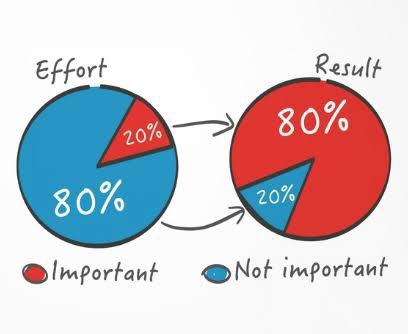
The Pareto principle (commonly used in business and economics), states that 80% of results come from 20% of actions. 80% of outcomes (outputs) come from 20% of causes (inputs). While it doesn’t always come to be an exact 80/20 ratio, this imbalance is often seen in various cases. For example, 20% of a firm’s customers might be generating 80% of its profits, 20% of a firm’s employees might be doing 80% of the work, 80% of the time we might be using 20% of the apps on our phone.
The rule was introduced by Italian economist Vilfredo Pareto. Pareto noticed that 20% of the pea pods in his garden were responsible for 80% of the peas. Pareto expanded this principle to show that 80% of the wealth in Italy was owned by 20% of the population.
The 80/20 rule can be used to prioritise tasks that we need to get done during the day. The idea is that, completing 20% of the tasks from our task list, will result in 80% of the impact we can create for the day. So in order have the most impact, we need to identify which tasks have the most impact for our team and focus on those.
We can apply this concept to any field – like personal finance, spending habits, relationships etc.
If you are an entrepreneur trying to grow your current business, an 80/20 mindset can help you to stay focused on your strategic plan and spend less time chasing endless new opportunities.
When faced with a number of problems, we should gather data and facts to identify the important few. The focus could then be put on attention and improvement efforts on those few things that would give the greatest improvement in quality.
The Pareto Principle helps us determine which areas to focus our efforts on. It helps us decide which resources are the most important for us to use to achieve the greatest efficiency. It helps reduce wasting time, money, supplies, efforts, emotions, energy etc.
Before you start working, ask yourself, “Is this task in the top 20 percent of my activities or in the bottom 80 percent?”
 Business With Balance