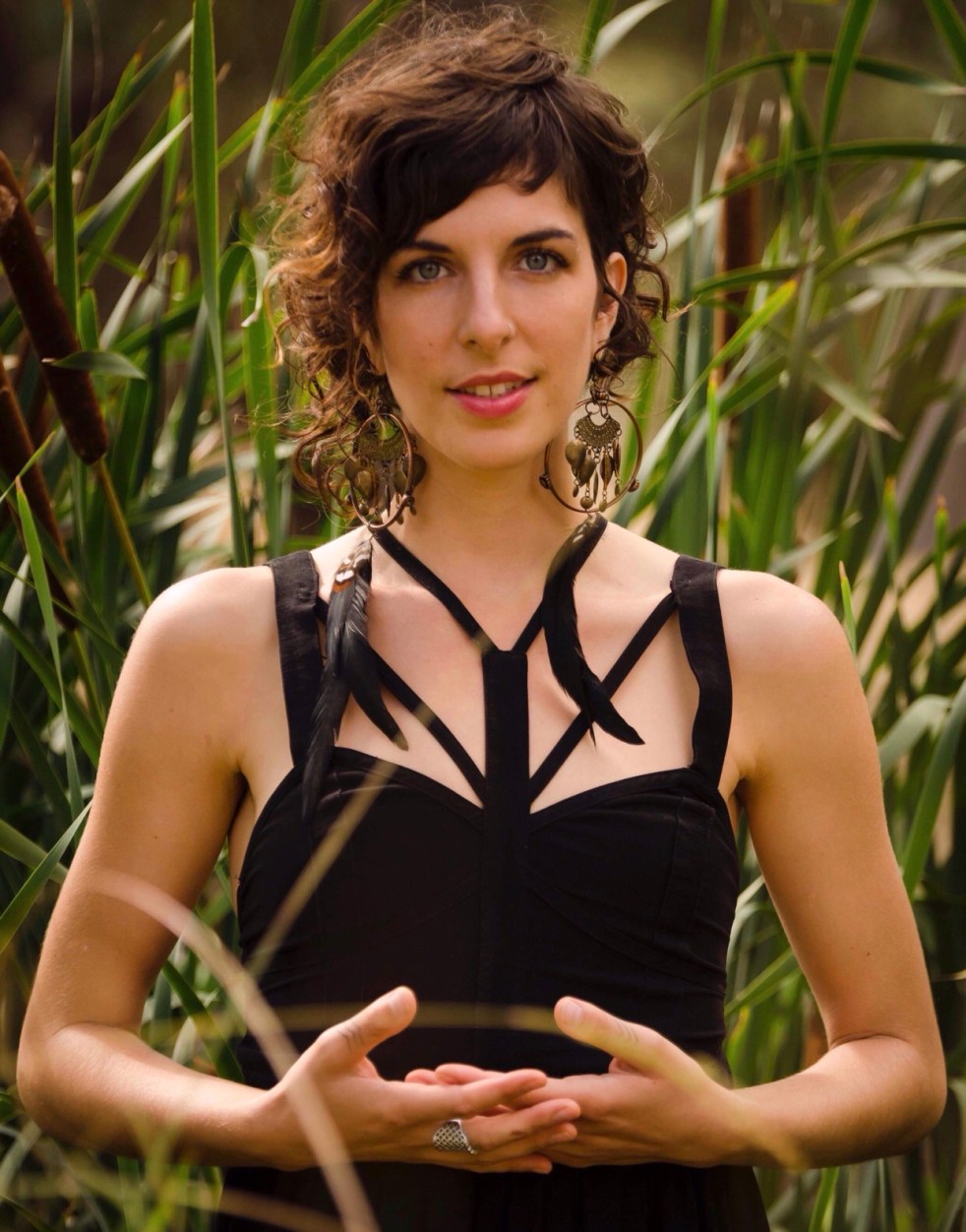
Meet our featured beauty with brains Lindsey Stilwell, an artist and activist based in Melbourne, Australia. She has overcome many setbacks in life including sexual assault, to be the inspirational person that she is today, awakening the embodiment of divinity in those she encounters and changing the lives of many through creative art therapy. Here is her story.
“I’m Lindsey Stillwell, an artist, activist and alchemist. I’m a chameleon of sorts – highly adaptive and a wearer of many hats. It has taken me many years to embrace the many facets and passions that make up who I am (and who I’m becoming). I used to think I was just indecisive, a people-pleaser, and trying to ‘fit in’, but I’ve come to realise, that my adaptability is actually one of my core strengths and a powerful tool to utilise. As an artist, I have always wanted to be ‘famous’, wanted to be in the spot light. I have come to see that underneath this, is my desire to SHINE and share myself with the world.
I have been a singer since before I could fully form words, and my feet have danced around the world. I have graced many stages in many ways, and have come alive in front of audiences. From singing in choirs to writing my own songs and merging the worlds of healing and music, I consider myself a ‘sound alchemist’, creating powerful transmissions through vocal tones, lyrics and songs.
My biggest creative project at the moment is creating a one-human show as ‘Lady Zee – dragtivist & queen’. Lady Zee is an androgynous drag queen, passionate about reclaiming empowered sexual expression, advocating for healthy boundaries, affirmative consent, and sexual assault prevention, while sharing her life experience of overcoming multiple accounts of sexual assault throughout her life. Activism has been at the core of my art and work for as long as I remember.
Growing up in a religious family, I was taught the value of service, compassion, and humility and my path has found me advocating for the voices of the voiceless, empowering those who feel unheard, and standing beside those who feel alone. From volunteering around the world in the slums of India, ‘red light’ districts of eastern Europe, hospitals in West Africa and rehabilitation homes for exploited girls and women in Nepal, to working as a social worker and mental health caseworker in Australia, my compassionate heart has been coupled with a passion for social change.
I first read Paulo Coelho’s book “The Alchemist” when I was 23. I had just moved across the world to follow a new romance, and was discovering mySelf as an adult in the world. I was deeply moved by his words, and this book became an instant favourite. Since then, much of my work and exploration has felt like alchemy – driven by my curious nature to explore what emerges when various elements are intentionally combined, merged or find a place of intersection. As a multi-modal Creative Arts Therapist, I infuse my therapeutic work with embodiment practices, emotional clearing, and mindfulness, offering a holistic path towards empowerment and wellbeing.
I am many things including artist, activist, alchemist; bringing transformation through exploration, creation and contemplation. My mission is to inspire and awaken the embodiment of divinity in those I encounter, to inspire others to live in connection with Life Force and as empowered creators of their own lives.
We asked her some questions.
1. Share an experience where you provided creative art therapy to a woman and it completely changed her life.
In my 8-week course ‘Untold Stories: a Therapeutic Arts Journey Uncovering Stories of Trauma and Shame’, I utilised various creative arts modalities including movement, music, visual art and embodiment processes to assist my clients in rehabilitating from previous traumatic or shameful experiences. The course was a progressive journey, culminating in a final ritual night, in which participants were invited to share their story through a creative art modality of their choosing. One of the participants shared her experience of returning to the love of drawing during the course (after not drawing for over 15 years), and how it impacted the way she perceived herself, her relationships, and the world. Additionally the embodiment exercises had a profound impact on her life, and she remarked that the course ‘changed her life’. As someone who previously felt very disconnected from her creative expression and her body, by the end of the course, she expressed feeling more connected to her body than ever, being able to notice the connection between her body, emotions, and relating with her partner, and the profound impact of being given permission to show up in her full expression, even if it felt ‘wrong’, ‘ugly’ or ‘uncomfortable’. I’m honoured to have witnessed her journey, and intend on continuing to see her thrive in the world!
2. What would you do differently if you knew nobody would judge you?
There’s not much I would do differently, although perhaps one area I feel held back in is publicly expressing the fact that I’m in a relationship with a woman. I feel my family would greatly judge me, and therefore keep this on a more personal level, and only subtly share about my relationship on social media. For the most part in life, I am pretty unrestrained and don’t really free being judged, as long as I’m in my own integrity.
3. What are some misconceptions about drag queens and identifying as ‘queer’?
When I tell people I’m a drag queen, many people often respond by saying “how?”, “you mean a king?” or “you can’t be a queen, you’re a woman”. It’s not common knowledge that there is a whole sector of drag artists that are female queens (often called ‘faux queens’ or ‘bio queens’). This can lead to feelings of marginalisation even in a marginalised community. As someone who identifies as ‘queer’, I also often get asked to clarify or people assume I mean I’m gay. For me, ‘bi-sexual’ is actually too limiting a term to represent my gender and sexuality, and the term ‘queer’ is much broader, basically meaning that I don’t subscribe to societal gender norms and am not a cis, heterosexual female.
4. Have you ever been a victim of sexual assault. If so, how did you overcome it?
I’ve been sexually assaulted four times throughout my life, at various ages from early childhood to adulthood. For many years, I didn’t talk about it or acknowledge what happened to me, and at 19 years old when I started to seek help, I was told that what I experienced ‘wasn’t abuse’. This led to feeling invalidated and shut down for a few years, and it wasn’t until I was assaulted a third time in my early 20s that I sought professional therapy. I saw a traditional psychologist as well as a psychotherapist who incorporated creative arts, visualisation, and Jungian theories into her practice. Eventually I went on to study Creative Arts Therapy, and while the academic environment was not a therapy setting, this helped my own process consequently. Alongside various therapies, I’d say some of the most profound healing came through my own self practices, particularly ecstatic dance, yoga and meditation. As I furthered my studies in Trauma Recovery, I applied the processes to myself, and found the more embodiment I did, the more whole I became in my healing journey.
I have endured many difficulties in life, and have a high level of resilience, so when I was raped in January 2017, I knew that even as devastating, confusing and painful as it was, I would get through. I moved into a rural environment, and set about self-healing once again, in conjunction with sessions with a psychologist at the Sexual Assault Centre, and a private alternative therapist. I’m proud to say that one year after being raped, I launched my 8-week course ‘Untold Stories’, and am in a powerful position to facilitate transformation and healing for others.
 Business With Balance